


DMC Pilot vs spreadsheetsWhen your DMC outgrows spreadsheets.
Many DMCs run on spreadsheets, WhatsApp and email, and run well on them. Here is when that works, what it starts to cost you, and how simple moving can be.
Almost every DMC starts on spreadsheets. A costing sheet per proposal, a manifest tab, a rooming list, a WhatsApp group per program and an inbox full of supplier confirmations. Everybody knows it, it bends to anything, and it costs nothing extra. For a while, it is the right tool.

The question is not whether spreadsheets are bad. It is whether keeping several copies of the same program in step now takes your team more time than one shared place would cost.
When are spreadsheets the right answer?
Stay on spreadsheets if most of these are true:
- You run fewer than about twenty programs a year.
- One or two people sell, cost and run every program, so nothing is handed over.
- The air manifest fits on one screen, and arrivals rarely spread across the day.
- Freelancers and suppliers do not need their own view of the program.
- You check the margin after each program, and you trust the number.
At that size, the entry plan and paid onboarding do not pay for themselves. We tell anyone who asks the same thing: below that, a well-kept spreadsheet is the honest answer.
Where do spreadsheets start to cost you?
Rarely in one big moment. The cost builds up in the handovers between tools, which every program goes through by hand:
- From proposal to operations. The itinerary and the sold costing are retyped into an operations sheet. Now there are two versions, and nobody is sure which margin is real.
- From flight tracker to drivers. A delay becomes a round of calls and messages. The transfer plan in the sheet is already wrong, and the driver may hear last.
- From supplier email to costing. A new rate or a changed headcount sits in an inbox. The client price and the margin are only updated if someone remembers.
- From team chat to the record. "38 showed up" lives in a WhatsApp group. When the season ends, the planned-versus-actual picture goes with it.
Other signs often come together: a file named final v7, a freelancer who can see the margin tab because they needed the transfer times, guest dietary and medical details in a shared sheet, and an owner who cannot answer "how is this program doing?" without asking three people.
How do they compare, job by job?
| The job | Spreadsheets, WhatsApp, email | DMC Pilot |
|---|---|---|
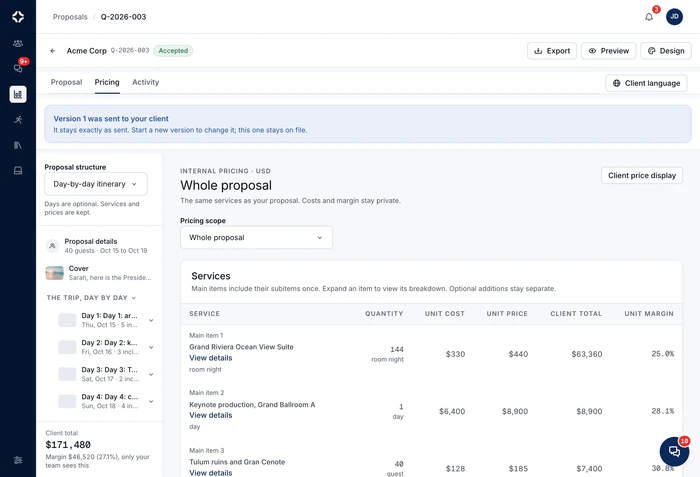
| Proposal and costing | A costing sheet per proposal, copied from the last one, then pasted into a document or slides. | A proposal builder that pulls from your own Products & Services catalog, with costing, margin and e-signature. |
| Turning the sale into the program | The itinerary and the sold costing are retyped into an operations sheet. Soon there are two versions. | The accepted proposal becomes the program. The costing you sold is kept, so live cost can be measured against it. |
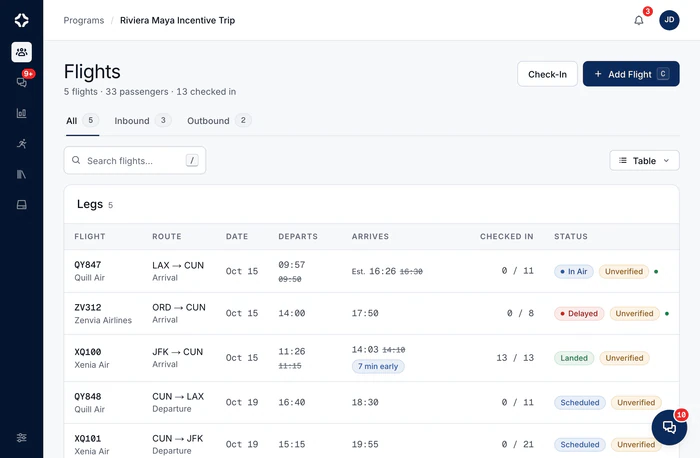
| Air manifest and transfers | A manifest tab, sorted by hand into transfer groups, and sorted again whenever a flight changes. | The manifest becomes transfer runs, grouped by airport and time. When a flight moves, a run not yet approved is re-timed, and an approved one is flagged for your team. |
| A delayed flight | Someone notices. Then a round of calls: the driver, the hotel, the client, the team group. | Flights on the manifest are tracked live. The change reaches the transfer plan, the program chat, the day sheet and Client View. |
| Supplier changes | The change sits in an inbox until someone updates the costing sheet, if they remember. | Suppliers confirm and answer change requests in their own portal. An accepted change updates cost, price and margin. |
| The team on site | A printed day sheet, a WhatsApp group and whatever is on each person's phone. | Day sheets built from the program, and a phone app with team chat and check-in lists that work without signal. |
| Who sees what | Whoever has the link. A freelancer who needs the transfer times can also see the margin tab. | You choose who sees what, by area and by program. Freelancers see only their own programs, and never money. |
| Margin, sold against actual | Checked by hand after the program, if there is time. | Client price, cost and margin, live, with each supplier's share. |
| Cost | Little or nothing beyond tools you already pay for. | Core $999, Growth $1,499 and Scale $2,499 a month, or 20% less on an annual commitment, plus paid onboarding. |
Airport transfers, day sheets, Client View and margin alertsare on Growth and up. The features page shows the plan for each feature.
What about WhatsApp and email?
WhatsApp is fast, and every driver and guide already has it. With some suppliers it will stay. The problem is not the app. Decisions made in a group chat never reach the program record, and nobody can look back through them when a client asks what happened.
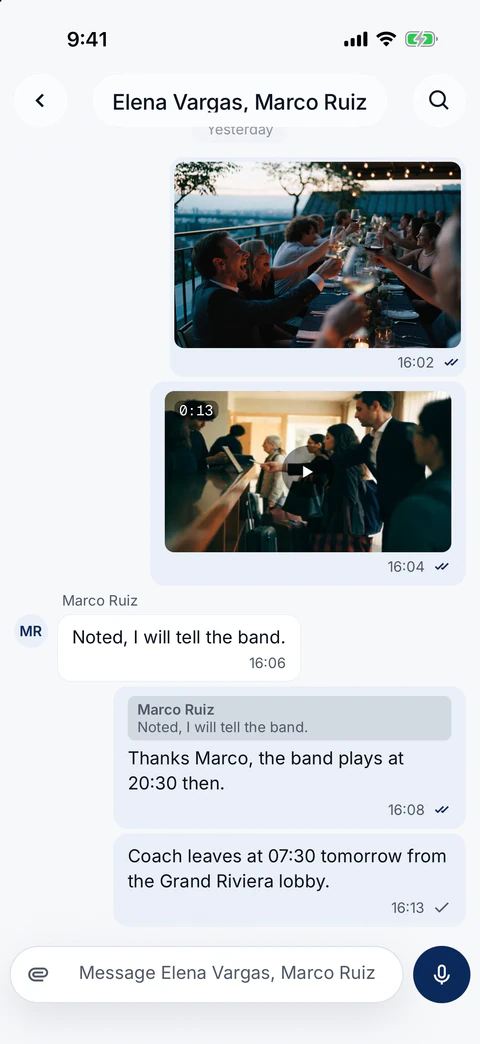
In DMC Pilot, your team talks in program channels and direct messages, with voice notes, photos and read receipts, on the web and on the phone. A flight change or a transfer change lands in the same thread. On Growth and up, Dispatch AI, the assistant built into DMC Pilot, spots final numbers in chat, such as a headcount, and asks a person to confirm them. Clients and suppliers use their own pages and links, not your chat. A supplier's record on the phone still opens WhatsApp in one tap.
Email stays where it is. On Scale and Enterprise, the AI inbox reads forwarded supplier emails and lists the changes they ask for, with the current value beside the new one. Nothing changes until a person approves it.
How do you move off spreadsheets?
Moving off spreadsheets is the normal starting point, not the exception. It usually takes about two weeks, and we do it with you:
- Before you commit. On the demo we ask how you price today. How your costing works decides the scope.
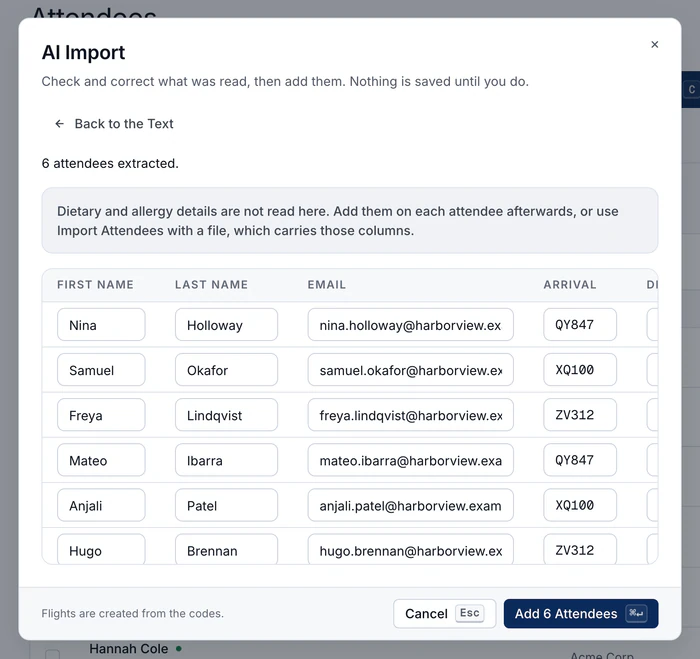
- Week one. We go through the setup checklist with you: company profile and logo, your team and their roles, destinations, then your price list and supplier rates imported. Guest and rooming lists import from CSV or Excel, with the columns matched for you. On Growth and up, clients, suppliers and your price list can also come in from CSV, Excel or PDF files, up to 20,000 new records at a time. Possible duplicates are flagged, and nothing is saved until you review it.
- Week two. Your suppliers are loaded and invited to their portal. We build two live programs together: ones you are selling or running now.
- From then on. Your team runs the programs, and we stay close through your first day on site.
Past programs are usually not worth moving. Leave them in the spreadsheets, and let that archive retire on its own.
What does DMC Pilot cost?
Three things: the subscription, paid onboarding, and about two weeks of your team's time. The plans are Core $999, Growth $1,499 and Scale $2,499 a month, month to month, with 20% off on an annual commitment. Enterprise is priced with you. Onboarding is scoped on the demo call, by the size of your catalog and supplier list.
What you get back is harder to put a number on, so we will not invent one. Here is a fair test: take one recent program, and count the hours spent retyping, chasing and checking, and the margin you could not see until it was over.
Can you get your data back out?
Yes. The company owner can download your company's records and files in one archive, and guest lists, finances and timesheets also export to CSV. It is a copy to keep, not a restore point. The details are in the FAQ.
What is the bottom line for DMCs?
At a handful of programs a year, spreadsheets are fine. Once your team hands programs from sales to operations, handles arrivals on many flights and works with freelancers on site, spreadsheets start to cost more than they save.
For a growing MICE, incentive or event DMC, DMC Pilot is the natural next step. One place takes each program from the proposal to the ground. Flights are tracked live, and transfers re-time themselves. Your team has day sheets and a phone app. Suppliers work in their own portal, the client has a live page, and you see the margin on every program.
Questions people ask
Is DMC Pilot worth it for a small DMC?
It depends on how many programs you run, not on team size. The plans are built for DMCs running 20 to 350+ programs a year. Below about twenty programs a year, the entry price and paid onboarding do not pay for themselves, and a well-kept spreadsheet is the honest answer.
Can we keep using Excel for some things?
Yes. Passenger lists, financials, timesheets and logs export to CSV. A proposal can be copied out as a spreadsheet, and reports download as PDFs. Many teams keep a spreadsheet for one-off analysis. The difference is that the program no longer lives there.
Do our suppliers and drivers need to install anything?
No. Suppliers sign in to a portal in your company's name with a code emailed to them. A transport company sees its runs there. Guests get links and never need an account.
Is there a free trial?
No. Onboarding is hands-on and paid, because DMC Pilot only shows its value with your own catalog, suppliers and programs in it. The demo call scopes it before you commit to anything.
Do freelancers take a paid seat?
No. Freelancers join free, up to a set number per plan, and see only the programs they are assigned to.
After the spreadsheet
The costing sheet, the manifest tab and the group chat, in one place.
Each detail is entered once, and everyone on the program sees the same thing.

Read next

See how costing works without a spreadsheet.
On a 30-minute call we ask how your costing works today, and whether moving would pay for itself. If it would not, we will say so.