


Flight delays for DMC groups and eventsHandle a delayed group flight in one place, with a record.
A group's flight is delayed, and 180 guests, nine coaches and a welcome dinner are already booked around it. This is where your DMC team handles it, and every smaller issue along the way. See every affected guest, transfer and supplier in one view. Message your team and post an update for your client. Keep the record a corporate client will ask for later.
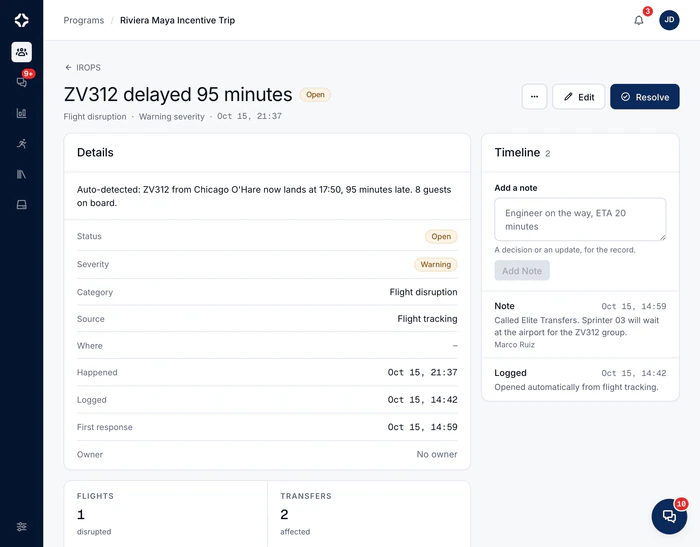
What happens to the transfers when a group's flight is delayed?
The disruption opens
It opens for you when a flight is canceled, diverted or 45 minutes late, or when a delay sends an approved transfer back for review. You can open one yourself too. Each is on the record from the moment it opens, and you close it when it is over.
See who is affected
The delayed flights, the transfers waiting on them, the suppliers to re-confirm and the guests on board appear together in one view.
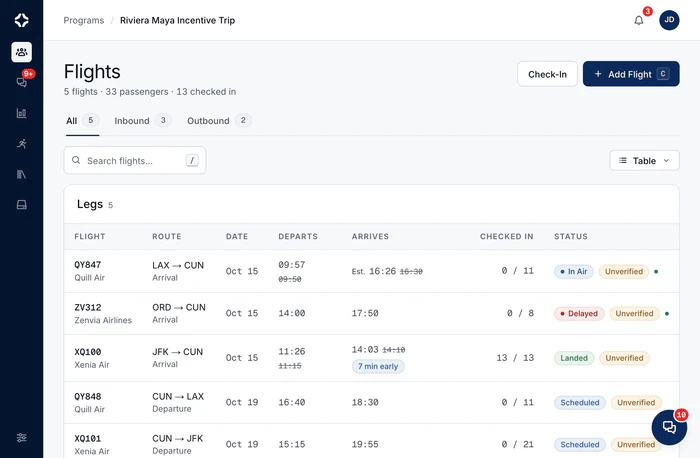

Every step of the disruption is recorded.
Who was told, what changed and what it cost, kept on the program.
Act from one place
Message the team, post the guest advisory, ask suppliers to re-confirm and plan the transfers again. One tap each, and each one is recorded.
Close it with a record
The duty-of-care timeline holds what was decided, when, and who was told. The issue also goes into the after-event report: facts, not memories.
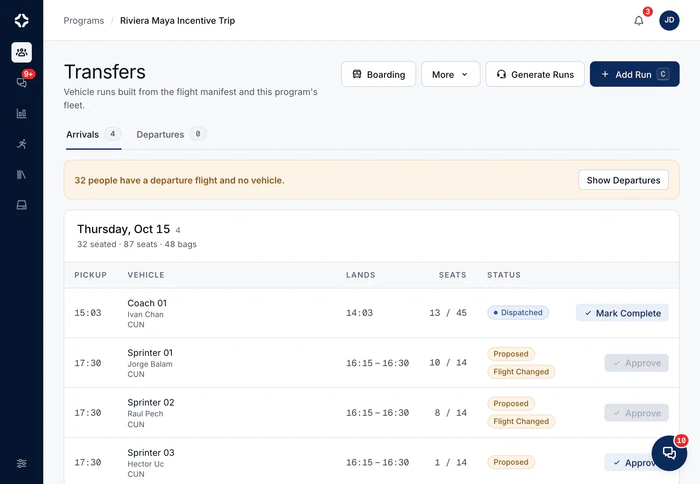
How does the team find out a group's flight is late?
Nobody has to watch the airline's website. Each flight on the program is checked every 10 minutes around departure and landing. When one moves, a transfer that is still a proposal gets the new pickup time. A transfer you already approved is never moved on its own: it is flagged Flight Changed for your team to review.
When a flight is canceled, diverted or 45 minutes late, a flight disruption opens on the program, with the guests, transfers and suppliers it touches already listed. Your team starts with the answer in front of them.
How do we tell the team, the guests and the client?
Two messages, kept apart. The team message goes to the program chat, to each person's notifications and to their phone, marked urgent when it cannot wait. The guest advisory is the one you write for the client. It shows on their page as a travel advisory.
Mass-messaging tools can reach everyone. But they do not know who “everyone” is tonight, which transfers they were on, or which suppliers need a new plan. DMC Pilot does, because the whole program is here: the flights, the transfers, the suppliers and Client View.
- Issues and change notes with a category, a severity, an owner, photos and estimated costs
- The guest advisory is separate from the team message: the client sees only what you write for them
- Advisories show in the travel advisory panel on Client View
- Ask suppliers to re-confirm and plan transfers again without leaving the issue
- An issue marked as holding health information cannot be posted as a guest advisory; voided entries stay on the record
- Included on Growth, Scale and Enterprise
How do we keep a duty-of-care record for the group?
Each decision can be noted on the duty-of-care timeline: what was decided, when, and who was told. Voided entries stay on the record. The issue also goes into the after-event report. So when a corporate client asks what happened, you have facts, not memories.
The same place holds the smaller issues of an event too, like a venue lost the night before or a coach that will not start. It is part of program operations, and it reads the delay from group flight tracking and the transfers from group airport transfers.
What else do DMCs ask about group flight delays?
When does a flight disruption open?
Flight tracking opens one on the program for you when a group's flight is canceled, diverted or 45 minutes late. You can open one yourself too, for a storm over the arrival airport or many flights canceled at once, and log smaller issues or change notes alongside it. Several can be open on a program at once. You close each one when it is over. It is not a dashboard that raises false alarms all day.
How does it know which guests and transfers are affected?
Because it holds the whole program: the flights, the transfers, the suppliers and the schedule. For a flight disruption, it lists the delayed flights, the affected transfers, the affected guests and the suppliers to re-confirm, in one view. Other issues link to the event, transfer, flight, guest or supplier they concern. Nobody has to work out at 2 a.m. who is affected. The program already knows.
What can we do from inside it?
Message the team: the message goes to the program chat, to each person's notifications and to their phone, marked urgent when it cannot wait. Write a guest advisory, which shows on Client View as a travel advisory. Ask suppliers to re-confirm, and plan the transfers again for the new times. Each decision can be noted on the duty-of-care timeline.
Does it act on its own in a crisis?
No, on purpose. In a disruption, your team stays in control. DMC Pilot shows what is affected and suggests what to do. An emergency tool that acts on its own is a risk. This one is a very fast pair of hands that still asks first.
Why is it called IROPS?
IROPS, short for irregular operations, is the travel industry's word for flights that go off plan, and it is what this part of DMC Pilot is called. Here it is built for a DMC's groups and events: the guests, transfers and suppliers on the ground. It is not software for an airline's own operations.
When a flight is late
See every guest, transfer and supplier a delay affects.
You see every affected guest, transfer and supplier together, message the team and post an update for the client.


See DMC Pilot in a 30-minute demo.
A 30-minute call with our team, using data like yours. If it fits, we set up your price list, suppliers and first programs with you.