


Choosing DMC software“DMC software” means two things. Here is how to tell which one you need.
Leisure booking systems and MICE ground-operations systems share a name, and little else. Picking the wrong kind costs months. Five minutes here tells you which one you need.
Why does “DMC software” mean two things?
Because two different kinds of company call themselves destination management companies (DMCs).
- Leisure and inbound DMCs sell travel product in their destination: hotel rooms, excursions, transfers and packages. They are often called inbound tour operators or receptive agencies. Their customers are mostly overseas tour operators, travel agents and online travel companies.
- MICE and incentive DMCs deliver meetings, incentive trips, congresses and events on the ground for corporate clients and event agencies. This is the world of ADMEI and SITE. Their work is a program: a client, dates, a headcount, an air manifest, a run of show and a sold price.
Both are real DMCs, and many companies do some of each. But each needs software built around a different kind of work, so the two kinds of software grew up almost separately. Most of what you find when you search “DMC software” belongs to the first kind.
What does a leisure tour-operator system do?
A leisure or inbound system is built around the booking and the rate. The typical core is:
- Supplier contracting: net rates, seasons, markups and cancellation rules.
- Inventory: allotments, availability and release dates.
- Quoting and itinerary building from contracted product, often in several languages.
- Reservations, booking files and vouchers.
- Distribution to trade partners, sometimes through a B2B portal or an online booking engine.
- Invoicing and links to accounting.
If you sell a lot of travel product at contracted rates, this is the kind you want. It is a mature field, with many established vendors.
What does a MICE ground-operations system do?
A MICE operations system is built around the program. It follows one client's event from the request for proposal (RFP) to the last departure:
- Answering an RFP with a costed proposal in the client's currency, with your margin visible.
- Turning the accepted proposal into the program, so nothing is retyped.
- The air manifest: who arrives on which flight, and which transfer they take.
- What happens when a flight is delayed and the group is already moving.
- Suppliers' confirmations, reconfirmations and changes, and what each change does to the margin.
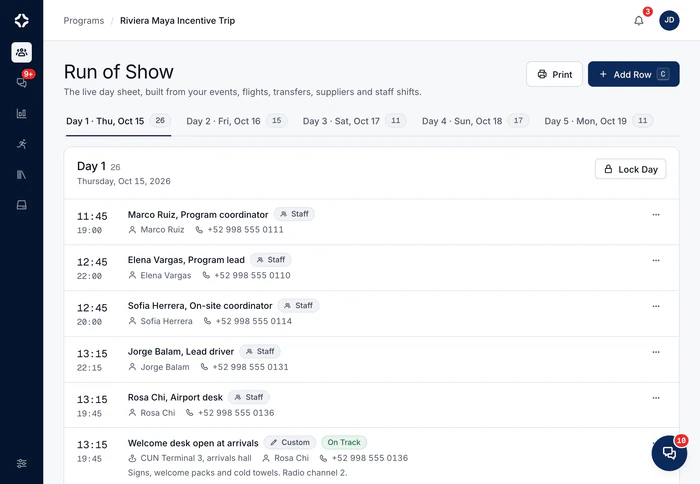
- Day sheets and a run of show for the team on site, on a phone.
- A live view for the client, and a report after the event.
The hard part here is not contracting. It is the live days, when hundreds of people move through a destination and the plan changes by the hour.

Which kind is your company?
Answer these five questions. The column you agree with most is your answer.
| Question | Leisure and inbound | MICE and incentive |
|---|---|---|
| What do you sell? | Travel product: rooms, tours, transfers and packages, priced from contracted rates. | A program: a client's meeting, incentive trip, congress or event, delivered on the ground. |
| Who buys from you? | Overseas tour operators, travel agents, OTAs and sometimes travelers directly. | Corporate clients, incentive houses and event agencies, often through an RFP. |
| What is one unit of work? | A booking or a reservation file. | A program with a date range, a headcount, a manifest and a sold price. |
| Where is the hard part? | Contracting, inventory, pricing rules and distribution. | The live days: arrivals, transfers, the run of show, staff, and the client watching. |
| What keeps you up at night? | A rate loaded wrong, an allotment released late, a voucher with the wrong date. | Forty flights landing across one day, a delayed group, a supplier change that eats the margin. |
What if your DMC does both?
Many do. A company might run incentive programs for corporate clients, and also sell excursions to cruise lines and tour operators. If that is you:
- Follow the money and the risk. Choose the system for the side that brings most of your margin, or where a mistake costs the most.
- Two systems can be the right answer. Some companies keep a booking system for leisure product and a program system for MICE work. That makes sense when the teams and the clients are different.
- Ask about the other side directly. If a vendor says it covers both, ask to see your hardest case from each side in the demo. Not a slide.
What should you ask a vendor?
A few questions separate the two categories quickly:
- Show me a program with 200 guests arriving on 30 different flights. How are the transfers planned?
- A group flight lands three hours late. What changes in the system, and who is told?
- How do I see the margin I sold against the margin I am actually making, while the program is running?
- How do suppliers confirm, and what happens when one changes a price?
- What does my team use on site, on a phone, with bad signal?
- How are net rates, allotments and release dates handled? (Essential for leisure, often absent from MICE tools.)
- Is it priced per booking, per user or per program, and what does onboarding cost?
- How do I get my data out if I leave?
To see the tools DMCs most often look at, and who each one is for, read DMC software compared.
Where does DMC Pilot fit?
DMC Pilot is on the MICE side. It is built for MICE and incentive DMCs, and it keeps everything in one place: sales and proposals, program operations, live flight tracking and airport transfers, suppliers, staff, a live page for the client, and Dispatch AI, the assistant built into DMC Pilot.
It is not a booking engine for inbound tour operators. There is no net-rate contracting, no allotment or release-date management, and no B2B distribution. If your business runs on those, a leisure system is the better choice.
What is the bottom line for DMCs?
If your company delivers corporate meetings, incentives and events, you need a MICE operations system. DMC Pilot is built for exactly that. It takes each program from the proposal to the ground. Flights are tracked live, and transfers re-time themselves. Your team has day sheets and a phone app. Suppliers work in their own portal, and the client has a live page. You see the margin on every program, and Dispatch AI answers from your own records.
Questions people ask
What is a DMC?
A destination management company is a local company that designs and delivers travel and events in its own destination. It uses its knowledge of local suppliers, venues and logistics. Two kinds of company use the name: those that sell leisure travel product to tour operators, and those that deliver corporate meetings, incentives and events on the ground.
Is a DMC the same as an inbound tour operator?
Sometimes. Many inbound tour operators and receptive agencies call themselves DMCs, and many MICE DMCs also handle some leisure groups. For software, the name matters less than where most of your revenue comes from.
Is MICE DMC software the same as event management software?
No. Event management software is usually bought by the company holding the event, for registration, badges and session apps. MICE DMC software is bought by the DMC delivering the program on the ground, for proposals, suppliers, transfers, staff and margin.
Can one system do both leisure and MICE well?
Some systems cover parts of both, so ask any vendor directly. In practice, the two kinds are built around different things: a booking or a program. A system is usually strongest where that matches your work.
Why do search results for “DMC software” look so mixed?
Because the phrase is shared. Most results describe inbound and leisure booking systems. Fewer describe MICE operations tools, and some unrelated industries use the same three letters. Add a word such as “MICE”, “incentive” or “tour operator” to your search for much cleaner results.
The live days
For the team that runs the program on the ground.
Guests arriving, pickups, the day sheet and your client's view, in one program.

Read next

Not sure which side you are on?
Tell us how your programs run. If DMC Pilot is the wrong kind of tool for you, we will say so on the call and point you to the right one.