
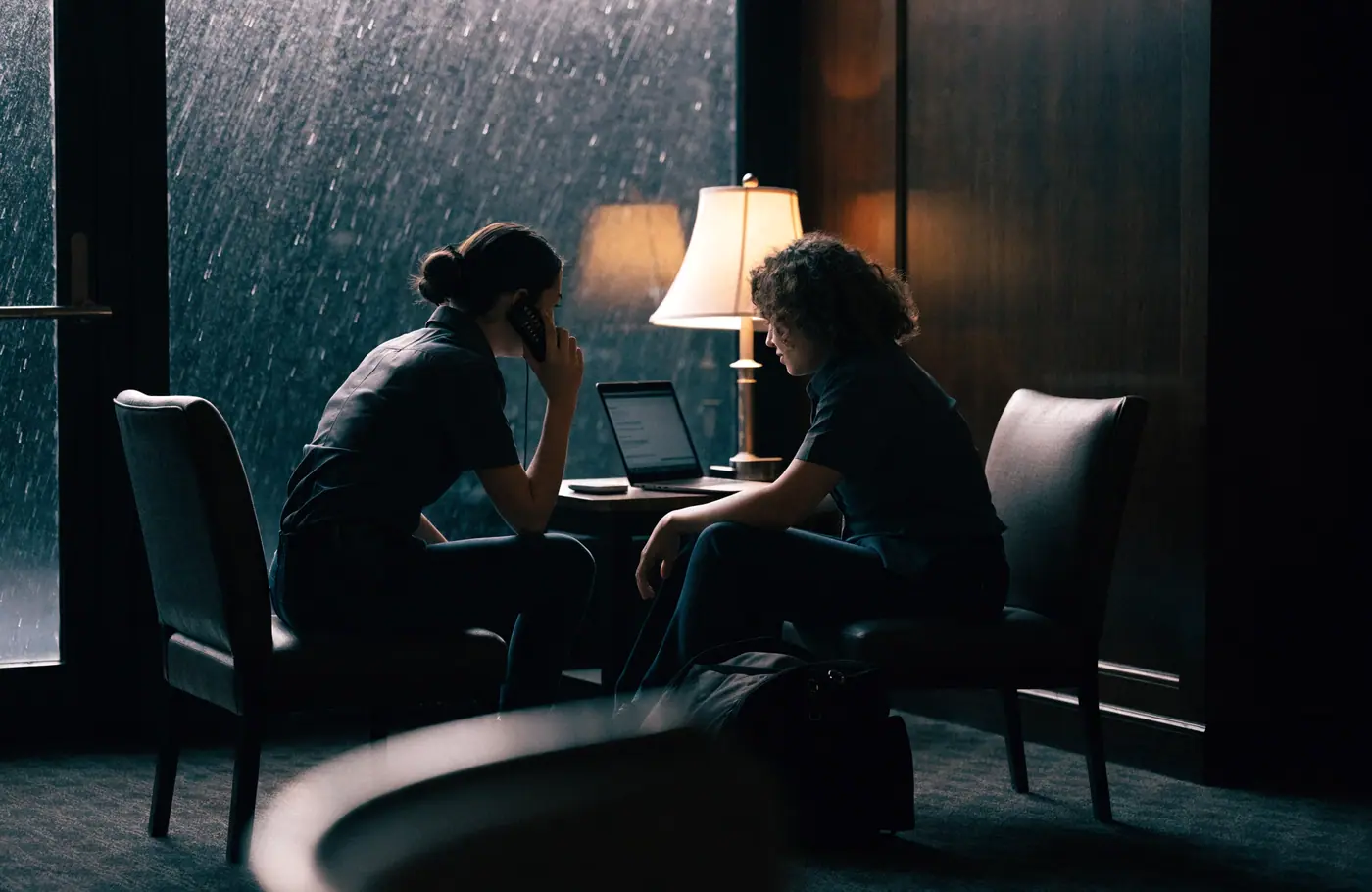
For the day the weather wins.
A mass delay hits the arrival wave. The War Room shows every affected guest, run and vendor in one view, hands you the broadcast and the guest advisory, and keeps the record a corporate buyer will later ask for. The difficult day, run to a procedure.
How a disruption is worked, start to finish
Open the room
Manually, or when the system detects mass disruption across a program's flights. Opening it is itself a logged decision.
See the blast radius
Affected flights, transfer runs, vendor assignments and guests resolve into one filtered view. No spreadsheet triage.
Act from the room
Broadcast to the team, post the guest advisory, request re-confirmations, re-optimize transfers: each a tap, each logged.
Stand down with a record
The duty-of-care timeline holds what was decided, when, and who was told: evidence, not recollection.
No standalone tool can do this.
Corporate mass-notification platforms can message everyone; they just don't know who “everyone” is tonight, which runs they were on, or which vendors need re-coordinating. The War Room is Arrival-to-Ground, the vendor network, chat and the cockpit composed into an incident view: it works because the program lives here.
- Guest advisory is guest-safe by construction: no internal detail
- Advisories surface in the Client Cockpit's travel advisory panel
- Re-confirmations and transfer re-optimization without leaving the room
- Same privacy and audit posture as the rest of the tenancy, heightened
- Included on Growth and Enterprise
War Room questions
When would we open a War Room?
A storm cell over the arrival airport, a mass cancellation, a venue lost the night before. It's an explicit mode you open on a program, and stand down afterward, not an always-on dashboard that cries wolf.
How does it know what's affected?
Because it holds the program: the manifest, the transfer runs, the vendor assignments, the schedule. Impact resolves across flights, transfers, vendors, guests and airport into one view. The question “who exactly does this touch?” is answered by the record, not by memory at 2 a.m.
What can we do from inside it?
Broadcast to the team, post a guest-safe advisory (no internal detail, ever), request vendor re-confirmations, and re-run transfer optimization against the new reality. Every decision can be noted for the record on the duty-of-care timeline.
Does it act on its own in a crisis?
No: deliberately. In a disruption the human stays firmly in control; the room surfaces impact and proposes actions. An emergency tool that auto-acts is a liability. This one is a very fast pair of hands that still asks.

See it on your own programs.
A 30-minute walkthrough with the team, on data that looks like yours. Sales-led onboarding: we load your catalog, your vendors and your first programs with you.